Home Field postings Mold Remediation Guides
Can an Air Purifier Get Rid of Mold?
An air purifier may capture some airborne particles, but it cannot remove mold growing on materials or fix the moisture that allows it to return.
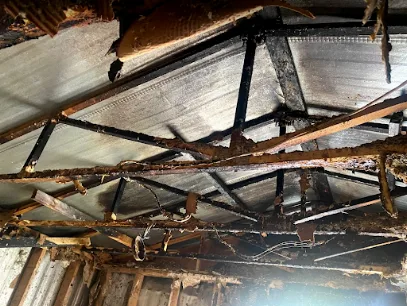
No. An air purifier can capture some airborne particles as room air passes through its filter, but it does not remove mold growing on a wall, carpet, or other building material. Nor does it stop the moisture that can support continued growth. Think of a purifier as an air-cleaning tool with a limited job, not a mold-remediation method: it may affect particles moving through the device, while cleanup and moisture control address the conditions and materials in the building.
An air purifier filters airborne particles, not a room’s surfaces
A portable purifier pulls air into an intake, moves it through a filter, and returns treated air to the room. Its effect depends on particles entering the unit and being captured. Particles that settle on a surface, or mold that is growing within or on a damp material, are outside that airflow path. The filter does not reach behind a wall, into carpet padding, or across a wet ceiling simply because the appliance is running nearby.
This distinction matters when interpreting what a purifier can accomplish. It can reduce some of the particles that pass through it; it cannot make a mold-stained surface clean or dry a water-damaged material. If a leak or condensation keeps an area damp, the underlying moisture condition remains. Air filtration and remediation therefore solve different parts of a problem: filtration acts on some airborne particles, while remediation addresses affected materials and the conditions that allowed growth.
Match the filter and device capacity to the room
Start with the filter specification rather than a broad label such as “air cleaning” or “sanitizing.” A clearly identified particle filter, such as a HEPA filter, is a more useful feature to evaluate for particle capture than an unspecified claim about fresh or purified air. Read the product information to understand what the filter is designed to capture and whether replacement filters are available for that model.
Then compare the unit’s stated room capacity or clean-air delivery rate (CADR), when provided, with the space where you plan to use it. These figures help distinguish a device intended for a smaller room from one designed to move more filtered air. For example, if you want to run a purifier in a large open living area, a model rated for a small enclosed room may not process air at the pace you expect. Use the manufacturer’s room guidance and the room’s actual layout to choose; a connected kitchen and living room do not behave like a closed, compact room.
Different claims also describe different functions. A particle filter captures particles from air moving through it; a device’s other advertised features may use a different mechanism. Compare the actual filter type and capacity rather than assuming every machine described as an air purifier performs the same task.
Placement and maintenance affect the air the purifier can process
Even a suitable unit needs an open path for air to move through it. Keep the intake and outlet clear of furniture, curtains, and stored items, and follow the manufacturer’s placement instructions. A purifier wedged beside a sofa or covered by fabric cannot circulate room air as intended. In a room with a strong source of particles, placement also affects which air reaches the intake; the unit is not a substitute for dealing with that source.
Filters are working parts, not permanent accessories. Check them on the schedule in the product instructions, and replace them as directed for that model. Dust accumulation and extended use can affect airflow, so a device that remains switched on is not necessarily processing air at its intended rate. Keep the model’s filter details and maintenance guidance together when planning ongoing use; filter names and replacement schedules are not interchangeable across products.
Treat device readings as particle information, not a mold verdict
A built-in indicator reports what its sensor is designed to detect, often a particular range or category of airborne particles. That reading is not an identification of mold species, a map of growth inside a building, or an inspection of damp materials. A display showing a lower particle level describes the air measured by that sensor at that time; it does not establish that a wet wall, carpet, or other affected surface has been cleaned or dried.
Use a sensor reading for the narrow question it can help answer: whether the measured particle signal in the surrounding air changes while the unit is operating. For decisions about mold, the relevant observations include where growth or water damage is present and whether the material is still getting wet. Those are building-condition questions, not conclusions that can be read from an air purifier’s display. Annapolis readers can learn more about H&H Restoration of Annapolis.
More field postings
- Does Mold Remediation Remove Every Mold Spore? Mold spores are a normal part of indoor and outdoor air. Learn what remediation is designed to change, why “spore-free” is not a practical g…
- What Should a Mold Inspection Report Tell You? A useful mold inspection report connects observed conditions, any sample results, and moisture evidence so you can understand what the findi…
- What Does Negative Air Pressure Do During Mold Remediation? Negative air pressure directs airflow into a contained mold-remediation area. Learn how the pressure difference, exhaust, and HEPA filtratio…